


For a long time the prevailing view was that governance was something only for large companies. The term itself, until recently unfamiliar, certainly contributed to that view, since many elements of governance are of course already present in mid sized companies. With its structured approach, governance is the operating system of a mid sized family business.
The aim of governance
The aim of governance can serve as the central starting point for the considerations needed and the decisions that follow from them. Because governance should
- anchor the owners' strategy in leadership and decisions,
- order the decision architecture and keep it able to act,
- secure earnings, liquidity and risk, and
- create the ability to handle succession and conflict.
The aim makes clear that governance is directed on the one hand at the family company (corporate governance) and on the other at the owner or owners and therefore the business family (family governance).
Parameters of governance
Governance is not an end in itself but a means to an end. Its scope has to fit the situation and the DNA of the company and the family if it is to work as intended. It has to work out the criteria that are relevant in each situation and prepare the ground for responding to future developments in the company and the family in a planned way. The basis is the owners' intent, which the owner or owners formulate in relation to strategy, risk and ethical and moral boundaries.
The parameters of governance come from the company and from the circle of owners. On the corporate governance side they include, for example:
- the size of the company or group
- the company and organisational structure
- the risk level of the business model
- international reach
- the financing structure
- external management
- an advisory board or supervisory board
On the family governance side the parameters include, for example:
- the number of shareholders
- the number of shareholding families
- heterogeneity
- generational levels
- the succession horizon
- potential for conflict
- what the company means to the shareholders
Together these parameters produce a certain level of complexity, which can also include the interactions between the constellation in the company and that in the owning family.
The level of complexity as the frame for the governance structure
Depending on the levels of complexity in the company and in the business family, a first assessment takes shape.
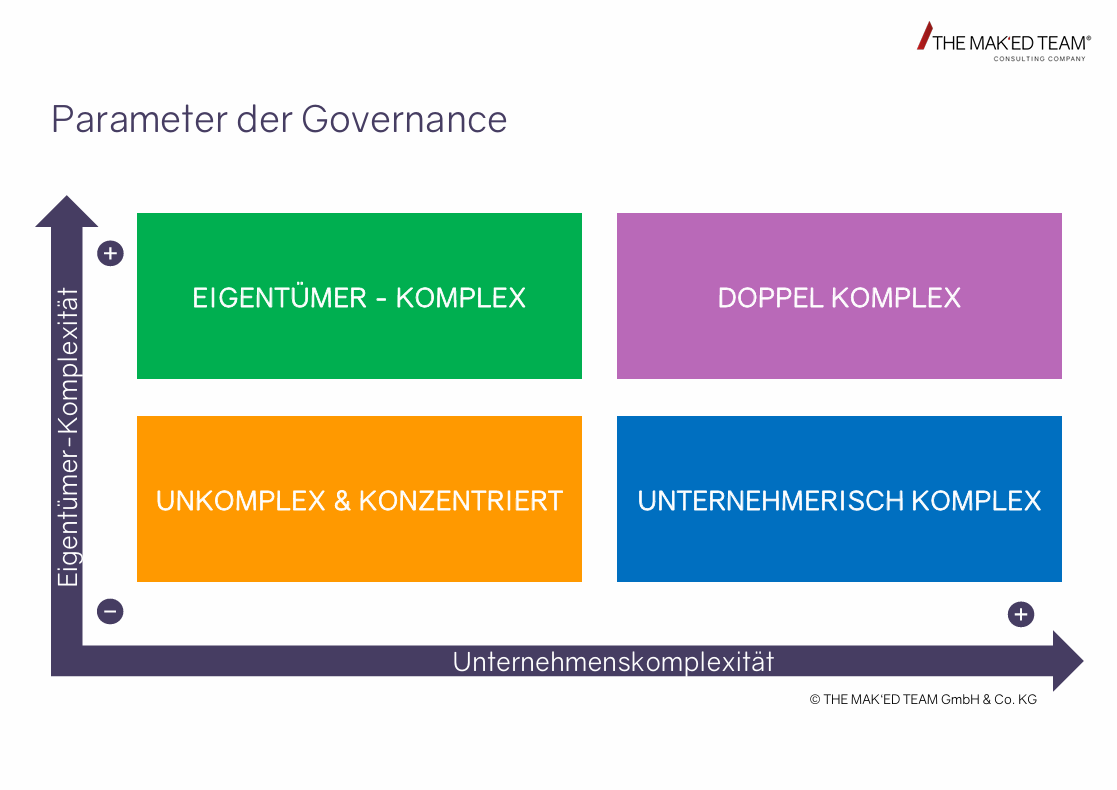
This first assessment gives orientation about your own situation in the relationship between company and family and the other way round. It challenges you to consider what you yourself regard as complex. The number of relevant parameters is the basis for the question of how extensive a governance system needs to be, from a minimal setting concentrating on a few relevant core topics through to an integrated code and a professional committee structure. Put differently: a company in the first generation of management, with a tax driven transfer of shares to the founder's child, faces different core topics than a company in the fourth generation with three shareholding families and management from outside the family.
The first assessment also sets the initial priorities and shows which sets of topics might, or indeed must, be dealt with first. Gaps in the existing arrangements can come to light, or changes in the company or the family can make it necessary to revise earlier decisions.
In summary
Governance brings together the topics that make the steering and leadership of family businesses possible, along with decision making within the business family. Working through those topics systematically creates the ability to act that is needed and makes succession possible.
Even so, this process of securing the ability to act and to hand over calls for intensive, trusting deliberation among the owners and the potential successors, whether in an operational role or as shareholders. Set up wisely, governance gives orientation to everyone involved and creates a binding set of rules. The owners shape the content.
THE MAK'ED TEAM works with mid sized companies and their shareholders to develop the right approaches and arrangements for active steering, leadership and succession. We know what is at stake for family businesses and business families.





.avif)