People & Culture

People are the central success factor in any company: good leadership, HR expertise and a culture of respect have a direct effect on performance and make lasting success possible.

Untersicht auf mehrere Menschen, die sich an den Unterarmen fassen und einen Kreis bilden

People are the key resource

As your company grows, so do the demands on leadership, responsibilities and collaboration.

Clear responsibilities, dependable workflows and good collaboration across departmental boundaries reduce friction, take pressure off managers and strengthen your company's performance. That creates the conditions for sustainable growth, stable results and strong competitiveness.

HR work only has an effect when tasks, responsibilities and processes are clearly settled. What often happens on the side in small companies needs dependable structures as growth continues.

Recruiting, onboarding, people development, employee support and administrative HR processes have to mesh with one another and fit your company's strategic direction.

Who does what? Who decides? Who develops the people? Clear answers to these questions provide orientation in daily work and take pressure off managers. The result: HR work that grows with the company and its challenges, and that delivers clear accountability, more transparency and better decisions within your company.

You will find examples of our successful "People & Culture" projects further down this page.

Would you like to put your HR work on a professional footing?

Arrange an appointment
Instructions
To make this component work with other components you must:
  1. Add a background color to the section div above ↑ this Timeline section. This is will help hide the progress line overflow.
  2. Add z-index-2 class to the section div above ↑ this Timeline section. This will ensure the oveflowing progress line from the Timeline section below ↓ is hidden underneath it.
People & Culture

People management maturity model

Our experience shows that even a few deliberate steps towards more professional HR work bring noticeable improvements to a company.

Clear structures, responsibilities and processes deliver more transparency, better decisions and stronger support for the company's goals.

HR work develops through a series of maturity levels. The overview below shows how HR can move from a largely administrative function to a strategic success factor for the company.

Level 1

HR as a necessary sideline

  • The necessary basic HR tasks get done
  • HR work does not carry much weight in the company
  • There are no clearly defined processes and structures
  • HR decisions are taken ad hoc by the management

Steps to level 2:

  • Create a structural framework for action
  • Define and fill the relevant HR roles

Level 2

HR as administrator & service provider

  • HR acts as the keeper of personnel records
  • There are first simple processes, but HR work is largely done manually
  • HR decisions are taken by the management and communicated by HR
  • Managers are the first point of contact for their people

Steps to level 3:

  • Extend the HR remit and the HR team
  • Build the essential structures and the processes to be automated

Level 3

HR as organiser & coordinator

  • There is an HR team with clear responsibilities
  • The focus is on administrative and organisational tasks
  • HR prepares the basis for management decisions
  • The basic processes are automated
  • There is capacity to take on further topics

Steps to level 4:

  • Extend the HR remit, roles and skills
  • Build out the HR structures and systems
  • Digitalise the processes

Level 4

HR as co creator

  • Administrative tasks carry the same weight as topics along the employee journey
  • HR topics are shaped and delivered proactively
  • There are clear HR structures with mostly digitalised processes
  • HR acts as adviser and companion to the management and to line managers

Steps to level 5:

  • Position HR work on a level with all other leadership functions
  • Take on responsibility as a strategic business partner
  • Digitalise all HR processes as far as possible

Level 5

HR as driver of transformation

  • The HR team is positioned at leadership level and works to advanced principles
  • HR is involved in every strategic decision that affects the people in the company
  • HR drives change and innovation proactively
  • HR processes are digitalised and optimised as far as possible
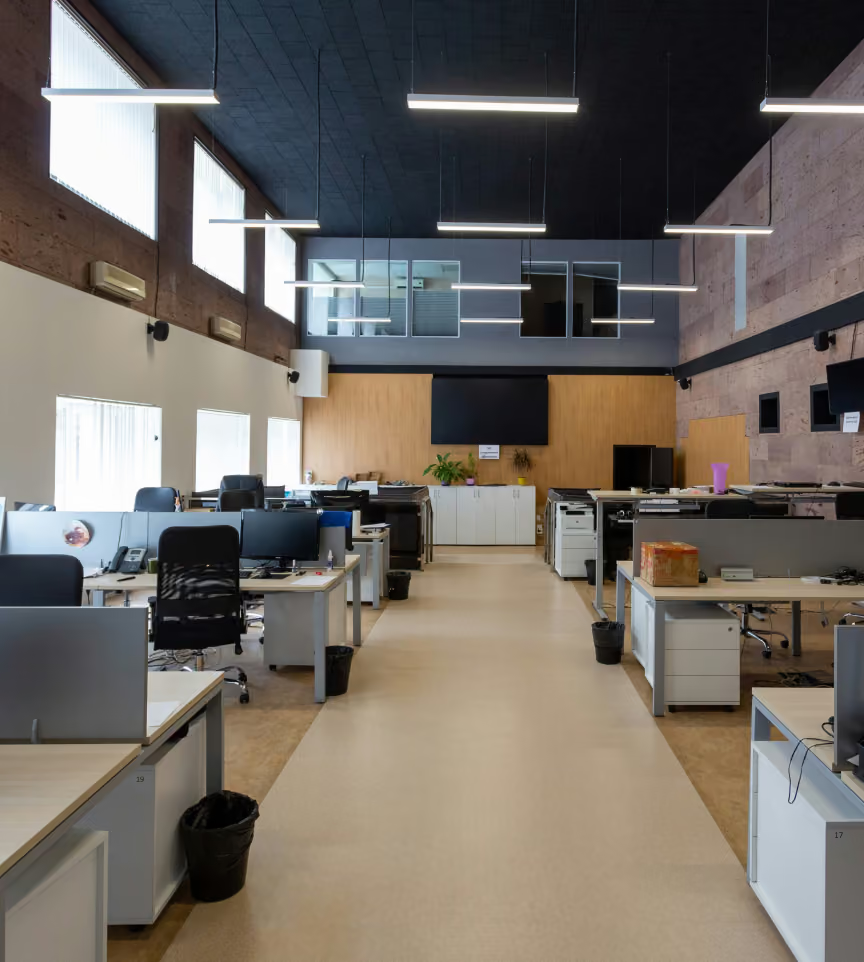
Großraumbüro mit Schreibtischreihen, Monitoren und Bürostühlen
Leading companies successfully

People & Culture

Digitalisation & AI in HR

The bottleneck in HR work today is rarely the technology. The challenge lies in connecting processes, systems and people in a sensible way. Most digitalisation and AI projects do not fail because of the technology. They fail because of unclear processes, missing standards and an inadequate data basis. Digitalisation creates the foundation that allows AI to become effective in HR at all. Only when processes are properly set up, data is reliably available and responsibilities are settled do digital solutions deliver value in everyday business.

Skills and qualification management

Growth, digitalisation and succession all raise the same question for companies: do we have the right skills on board? Skills and qualification management creates clarity about the know how that is available and where gaps are opening up. That lets you develop your people deliberately, make better use of their potential and secure successions early. The result: skills are not left to chance but built up exactly where the company needs them to succeed.

People development & learning culture

Training alone does not develop a company. What matters is that learning pays into the company's goals. Managers and employees share the responsibility for building and developing skills systematically. A learning culture that is actually lived creates the conditions for putting new knowledge into practice quickly and for delivering change successfully. The result is not a set of isolated training measures but the continuous development of people, teams and the organisation.

Systematic remuneration & pay transparency

As the requirements for pay transparency rise, many remuneration models that have grown up over time reach their limits. Salaries, career levels and responsibilities have to fit together and be understandable for employees. A systematic pay structure provides orientation, strengthens confidence in salary decisions and makes prospects for development visible. The result: remuneration that combines fairness, competitiveness and company culture.

HR compliance / governance

With every additional location or country, the demands on steering HR work increase. Differing processes, systems and local rules make transparency, comparability and decisions harder. HR governance creates clear standards for roles, responsibilities, processes and data structures across countries and sites. At the same time HR compliance makes sure that employment law and regulatory requirements, from data protection through working time to health and safety, are firmly anchored in the HR processes. The result is HR work that can be steered across locations, scaled digitally and relied on legally: clear responsibilities, uniform standards, dependable decisions and an HR organisation that effectively supports the company's growth.

Workforce planning

Which people and which skills does your company need to reach its goals? Structured workforce planning creates clarity about future staffing needs and takes growth, retirements, turnover and new requirements into account early. That way you take staffing decisions on a sound basis rather than under time pressure. The result: the skills your company needs tomorrow are available in good time, through targeted development, internal moves or new hires.

PROJECT EXAMPLES

People & Culture

Choose a topic

Systematic remuneration & development

Industry: Mid sized retail company

Our role: Consultant, process facilitator, project manager

Project objectives

  • Modernising the remuneration structures to increase transparency and fairness
  • Strengthening competitiveness through pay that is comprehensible and future oriented
  • Avoiding dissatisfaction and staff turnover through clear criteria and orientation for employees
  • Meeting legal requirements such as the pay transparency obligation

Key results

  • A transparent salary structure with comprehensible criteria for all employees
  • Binding remuneration principles as a cultural and strategic point of reference
  • Internal imbalances reduced and employee retention improved
  • Greater appeal as an employer through modern and fair remuneration models
  • Efficient steering of people development through clear career paths and prospects for salary growth

Approach

  • Analysis of the current situation: survey of the existing remuneration models and identification of ambiguities and room for improvement
  • Benchmarking: comparison with other companies and industries to derive best practice
  • Definition of guiding principles: clear rules for fair and transparent pay (for example performance, market comparison, responsibility)
  • Introduction of a grading system: job profiles, career levels and skills models linked to salary bands
  • Review of the existing target and bonus systems: alignment with strategic goals and their effect on motivation
  • Structured delivery: development and adjustment of job descriptions, allocation to job families and communication of the new remuneration logic

Professionalising HR work with the introduction of an HR management system: SAP SuccessFactors

Industry: Mid sized textile services company

Our role: Consultant, process facilitator, group wide project lead

Project objectives

  • Standardising and unifying the HR processes across sites in three countries and mapping them in SAP SuccessFactors
  • Introducing the Employee Central, Recruiting, Onboarding and Learning modules in phase 1
  • Implementing all country specific rules, compliance and data protection requirements in the system
  • Integration into the existing system landscape
  • A significant reduction in manual work
  • Meeting legal requirements such as the pay transparency obligation

Key results

  • Process unification: HR processes harmonised across all sites
  • A group wide HR management system creating a standardised, efficient way of working and transparent data, for example for people analytics
  • Accompanying change management, firmly anchored, with local change agents in every country

Approach

  • Modernising the remuneration structures to increase transparency and fairness
  • Strengthening competitiveness through pay that is comprehensible and future oriented
  • Avoiding dissatisfaction and staff turnover through clear criteria and orientation for employees
  • Meeting legal requirements such as the pay transparency obligation

Replacing & introducing an HR system

Industry: Mid sized services company

Our role: Consultant, project manager, process facilitator

Project objectives

  • Replacing the legacy HR system & implementing a new HR management system
  • Mapping the HR processes in the new system & integrating the new system seamlessly into the company's existing process landscape

Key results

  • Personio implemented as the company's HR management system
  • Successful migration of all relevant data
  • Smooth process flows assured within the system and through interfaces to other systems

Approach

  • Definition of the general requirements for the system and of the processes it has to map
  • Definition of the technical requirements including the interfaces needed to other systems
  • Comparison of various HR management systems & selection of Personio, taking the relevant factors and the budget into account
  • Setting up the project management: framework, roadmap and a communication concept
  • Preparing and carrying out the data migration: master data, company data, process data, and mapping the necessary HR processes, roles, access rights and automation in Personio
  • Testing all functions before the system went live
  • Supporting the rollout with professional project management,  communication measures and training

Implementing workforce planning

Industry: Construction

Our role: Consultant, process facilitator

Project objectives

  • Analysis of the current situation and implementation or further development of strategic workforce planning to reach the company's goals
  • Development of a roadmap for establishing an annual strategic workforce planning process, securing the necessary skills and anchoring the process in the company's existing structure

Key results

  • Strategic workforce planning embedded in the existing company processes, securing the skills needed to reach the medium and long term company goals
  • The workforce planning process anchored in the existing structures and processes, with smooth communication assured between production and HR

Approach

  • Analysis of the current situation:
    • Is there any strategic workforce planning?
    • What medium and long term goals does the company have, and which people and qualifications are needed for them?
    • How much turnover is there at present and how much is to be expected in the coming years (retirement and so on)?
  • Development of a strategic process for planning staffing needs regularly
  • Development of the necessary measures and detailed design of the actions arising from the process, together with the business areas involved
  • Support for carrying out the workforce planning

Implementing Workday Learning and the organisational development that goes with it

Industry: Motors and drive technology

Our role: Project manager, process facilitator, change manager, workshop facilitator

Project objectives

  • Implementing Workday Learning and replacing the previous corporate learning processes and systems
  • Organisational development to change the way the organisation learns
  • Changing the learning culture

Key results

  • Workday Learning implemented in the company
  • Smooth process flows assured within the system and within the responsible team
  • Employees actively brought into the new learning culture through direct communication, events and opportunities to exchange experience

Approach

  • Analysis of the current and the desired state regarding the scope and use of Workday Learning, the necessary processes, the change for the responsible team and the learning culture in the company
  • A project plan for implementing Workday Learning, design of the individual project measures and definition of the project steps with the goals to be reached at each one
  • Active stakeholder management: regular alignment with bodies such as the works council, data protection, IT security and other relevant internal stakeholders on project management and the setup of the system
  • Preparation of data migration and data archiving including a deletion concept
  • Running and supporting test phases of Workday Learning in the company and providing expert support in adapting the system to the company's needs and processes
  • Translating business needs into IT functionality
  • Setting up and supporting change management and a communication plan for the rollout through various measures and channels
  • Anchoring the processes and documenting the results

Introducing a skills model

Industry: Construction

Our role: Consultant, companion

Project objectives

  • Working out a skills model
  • Implementing the skills model in the existing HR management and its instruments

Key results

  • A simple, understandable skills model geared to actual needs
  • Structures and processes developed to embed the skills model in the existing HR instruments, including transparent internal communication
  • The skills model embedded in the existing HR management system

Approach

  • Analysis of the existing structures: employees, job and role descriptions, skills profiles, HR processes, people development, HR management system
  • Development of a roadmap for building and introducing the skills model, including a communication concept
  • Development and introduction of the skills model, starting with one defined business area as a pilot and closely linked to the strategic direction
  • Embedding the model in the existing HR management: employer branding, recruitment, appraisal conversations, development and career paths, succession planning

Introducing a learning management system and training online trainers

Industry: Educational institution (Mali)

Our role: Consultant, companion

Project objectives

  • Creating a modern infrastructure for distance learning and teaching
  • Building the instructors' skills in distance teaching

Key results

  • A changed learning and teaching culture
  • Structures and processes developed in the organisation for looking after the online courses and their participants
  • Instructors trained as online trainers, with the established learning management system used for the first courses
  • The institution managing and organising the online courses independently

Approach

  • Developing the previous learning platform further with a new Moodle system
  • Introducing the instructors to virtual learning and teaching
  • Establishing the technical basis for developing courses for Moodle
  • Building the people development team's skills in agile learning culture and digitalisation
  • Training a local team of administrators to look after and develop the learning management system

Taskforce: analysing, designing & delivering measures to maintain business critical qualifications

Industry: Infrastructure

Our role: Consultant, project lead, facilitation

Project objectives

  • Creating a single data basis for transparency about the backlog of qualifications
  • Delivering short term measures and working out a medium to long term strategy for covering qualification needs robustly

Key results

  • Transparency about business critical qualifications
  • A medium to long term strategy for covering qualification needs robustly

Approach

  • Analysis of the current state of business critical qualifications: a single data basis to quantify the backlog, the needs and the resources
  • Development of short, medium and long term measures to catch up on qualifications and to carry them out further under the applicable coronavirus health and safety rules
  • Decision rounds with the executive board, the works council and the divisional management
  • Continuous review of the status quo of qualifications and comparison of actual against target
  • Development of a future proof strategy for a robust approach to qualifications

Developing, implementing and managing a training academy for customer & employee training

Industry: Medical technology

Our role: Consultant, project lead

Project objectives

  • A worked out concept for an internal training academy
  • An established training academy
  • A trained management team for the training academy

Key results

  • An established training academy that pays for itself on a lasting basis and is run by its own team with standards and processes
  • An established quality management system

Approach

  • Analysis of the current state of training for customers and employees
  • Analysis of the training need, at a high level and in detail
  • Definition of the goals to be reached with the training academy
  • Development of the strategy within strict budget limits to reach break even on plan, with a strong sales focus to secure the revenue targets
  • Design of training products, services, sales & marketing
  • Implementation of the concept and of the structures and processes required
  • Management of the training academy and its step by step handover to the local team through mentoring, coaching and training

Developing and implementing a qualification management system

Industry: Medical device manufacturer

Our role: Project lead

Project objectives

  • Clear structures and processes in the organisation and in people development
  • Qualifications and mandatory training per role in the company have to be traceable

Key results

  • Clear structures and processes for HR topics
  • Full traceability of qualifications
  • Proof of mandatory training can be provided

Approach

  • Analysis of the current state regarding legally required
  • mandatory training and training under DIN ISO 9001 and DIN ISO 13485
  • Development of a role concept that fits the organisation
  • Allocation of roles to employees
  • Allocation of mandatory training to roles using a qualification matrix
  • Development of a process for putting qualification management into practice and
  • mapping it in a digital learning platform (LMS)
  • Introduction of onboarding plans and training records
  • Evaluation and reporting of actual against target in qualification management

Discover more categories

GET IN TOUCH

We take the time.
For your future.

Get in touch with us. After one personal conversation you will know exactly what THE MAK'ED TEAM can do for your company.

We look forward to your message.
Thank you! Your submission has been received!
Oops! Something went wrong while submitting the form.